Showing posts with label singapore. Show all posts

Wednesday, April 13, 2011

REWARD for MISSING DOG: Lucky

I got this missing pet alert from Sam Choo ..I'm posting it here to help find Lucky and other missing pets. Pls. help spread around .Thank you.

It is not a lucky day for Lucky cos she is missing.

 LUCKY the husky-whippet cross was lost in the vicinity of 2 Lew Lian Vale, Jade Tower near Serangoon Nex yesterday.  She has her harness and leash still on. She heard a loud noise and dashed off between Bartley Road and How Sun Road.

Please help the owners find her. She has been through so much and finally found a good home. The owners Christine and Marcus are so very sad and worried. Please help them keep a lookout for her. She is vaccinated, micro chipped and sterilized.

Name:    Lucky
Breed:    Whippet-Husky Cross
Gender    Female
Age    2 years old
Microchip    Ends with 626
Color    Off white. Her eyes are two different colours. One brown and one white
Last Seen    The road between Bartley and How Sun Road
Date Missing    13 April 2011, 6pm
Reward    Reward will be given for safe return
Owner    Christine/Marcus
Owner's Contact    9793-7162/9697-3491
Appeal by owner     LUCKY the husky-whippet cross was lost in the vicinity of 2 Lew Lian Vale, Jade Tower near Serangoon Nex on 13th April She has her harness and leash still on. She heard a loud noise and dashed off between Bartley Road and How Sun Road. Please help us find her. She has been through so much and finally found a good home. We are so very sad and worried. Please help us keep a lookout for her. She is vaccinated, micro chipped and sterilized. Reward for safe return. Please help

Tuesday, April 12, 2011

REWARD for MISSING DOG : COCO

COCO, a 5 month old Yorkshire Terrier went missing at Banyan Villas, 64 Lentor Road (Singapore 786571) on 9th April 2011 at about 9:30 am. She went under the garden gate and stood there. She vanished in half an hour. Someone must have taken her from then on.


Name:
Coco
Breed:Yorkshire Terrier
GenderFemale
Age5 months
ColorBlack & Brown
Last SeenBanyan Villas, 64 Lentor Road 786571
Date Missing9th April 9:30 am.
RewardReward will be given for safe return
OwnerRosa
Owner's Contacttel 9446-2888 or email rosamurphy5@hotmail.com
Appeal by ownerWe think she went under garden gate and stood there. Someone must have taken her from then on.
Posterspdf, jpg format

Thursday, February 24, 2011

Justin Bieber Concert in Singapore --huweeeeeh!

I wanna watch this kid perform LIVE in Singapore! Plsssssss....pleeeaaaseeeeeeeeee!

Justin Bieber heading to Singapore in April


It's confirmed - Justin Bieber has a date with Singapore.
The LAMC Productions werbsite announced that Bieber will perform at the Singapore Indoor Stadium on April 19, 2011.
The performance is part of his international "My World" tour.

Singapore will be Bieber's first stop on the Asian leg of the tour.
The Canadian pop/R&B singer recently caused a stir among his Twitter followers over his new hairstyle.
About 80,000 fans unfollowed him on Twitter after he snipped off his trademark locks.
He gave a lock of his hair to talkshow host Ellen DeGeneres, who is auctioning it off for charity.
Priority booking for Visa cardholders is from Feb 28 to March 13, while public ticket sales commence March 14.
Ticket prices range between $98 to $250.


Tuesday, February 15, 2011

Missing Golden Retriever: Pebbles (Singapore)

Pebbles, a female Golden Retriever was latched to the main gate. Suddenly the dog went missing and the leash was cut. It was believed to be stolen at Jupiter Road, Winsor Park (Upper Thomson Road) on 8th Feb 2011.

It is 8 months old. The microchip number ends with 4741.
If you have any info on this missing dog, please contact owner. Reward if found.


- Posted using BlogPress from my iPhone

Thursday, January 27, 2011

Missing Pet: Miki ( Shih Tzu) --> FOUND!

Hooooray! Miki has been found!


The owner is very sad over the loss. Yesterday the Shih Tzu slipped out when the door was open and it could not be found. Despite putting up the posters, it was removed by persons unknown. If you are living nearby please help to look out.  If you have a website or blog, please post it.  And pass the word around to your friends.


Name:Miki
Breed:Shih Tzu
GenderMale
Age11 year old
FeaturesNot wearing any collar or microchipped
SizeSmall
Last SeenBlk 717 Pasir Ris St 72, Singapore 510717
Click here for map
Date Missing27th Jan 2011
ContactSze Chin at oszec@yahoo.com or
tel 9225-3177
RewardReward for safe return
Posterpdf. jpg.


Friday, January 14, 2011

Global Forum on IP: Report 2

Celebrity Leveraging

Robert Raskopf, partner at Quinn Emanuel Urquhart & Sullivan LLP was up after the coffee break discussing the exploitation of celebrity rights in the US. The right of publicity is a state based right without federal law intervention, despite a movement to see a federal statute. The right of publicity allows individuals to control the commercial use of their name, image and the like. The first mention of a right of publicity came from an article written by Justice Brandeis in the Harvard Law Review written over 120 years ago about the right of privacy including, amongst others, intrusion, false light, and public disclosure of private facts. Even back in 1890 the reasons for the establishment of the right of privacy had to do with the encroachment of technology, such as cameras and telephones, on private life. This is the same continuum that we see today.

There are 28 states that have a common law right to publicity and another 19 that have statutory based rights of publicity. The one that has the greatest protection is that of Indiana whose statue protects a person’s right of publicity for 100 years post mortem and extends to a signature, appearance, gesture or mannerism which may indicate that person’s personality. Indiana is also home of
Curtis Management (CMG) which includes in its portfolio that of Amelia Earhart, Mark Twain, James Dean and Babe Ruth, which is why we see Indiana with such strong protection. In California, the Astaire Celebrity Image Protection Act passes rights of publicity to heirs with protection at 70 years post mortem. New York, however, is at the other end of the spectrum which has a much narrower protection under Article 5, Section 51 of their Civil Law Statute and by virtue of Pirone v MacMillan where the Second Circuit held that the right derived from privacy and not from publicity, and therefore there were no transferable rights of publicity following death of the individual.

Typically, where the potential plaintiff is domiciled when they die can create a lot of difficulties dependent on the state’s law. The Marilyn Monroe case exemplified this as her domicile was held to be that of New York and not of the claimed California so she lost the right of publicity which had earned her at least $30 million before she died. The lesson being if you are going to die, die in Indiana.

Raskopf cited the case of CMG Worldwide v The Upper Deck Co., Inc case where he acted for the defendant. CMG owns the rights of publicity and is the licensing agent for several deceased Major League Baseball players including Lou Gherig. It had licensed Topps the exclusive rights to use some of these players images. The case was filed in Indiana against Upper Deck who put out a baseball card for every one of the Yankee games including a set which was interspersed amongst the nine other series that they intended to release. The cards had been made and ready for distribution, but CMG obtained an injunction in Indiana Federal Court which meant that they could not ship the cards. The Defendants were able to ascertain that none of the players at issue were resident in Indiana at the time of death and the case was transferred to New York and went on to settle. The Indiana court then denied the temporary restraining order which would have crippled the client’s distribution and business reputation - the cards of which were worth about $100 million. In another case Upper Deck had a licence to use an image of Derek Jeter but didn’t have rights from the MLB to show aspects of his employment including the uniform of the NY Yankees which is owned by the MLB. An injunction was applied for but again was rejected.

At the Supreme Court level there has only been one case of Zacchini v Scripps- Howard Broadcasting Company, otherwise known as the Human Cannonball case where the defendants broadcast the entirety of a 15 second clip of a guy shooting himself out of a canon. Although it was essentially a news report, the entire act had been shown so people would therefore no longer have a reason to go see him in person as they had already seen it.

He stated that there is some resistance from the Media Bar in the move for greater protection of rights of publicity. There was a case of a SuperBowl commercial run by Hyundai in which half of a second of the 30 second ad called "Luxury" showed an image of a Louis Vuitton repeat pattern a basketball. The purpose of this was to show new ideas of luxury. LVMH sued because of the use of this 'semi-logo'. He stated that this action was kind of a way of LVMH controlling their image. He questioned how far one can go in attempting to control an image in such circumstances. Raskopf’s personal point of view is that the First Amendment is more paramount than that of the celebrity’s right to control their image.

Views from the Bench: The Next Ten Years in Intellectual Property

The judges were up next looking into their fuzzy crystal balls for the next ten years in intellectual property. The chair, David Llewelyn, opened up by asking what a collective of judges is called and suggested it is a “gaggle”

Justice Andrew Phang, Judge of Appeal from the Supreme Court of Singapore stated that the body of IP law in Singapore is rapidly growing in comparison to how relatively small the jurisdiction is. The courts are also drawing increasingly on the case law of other jurisdictions and try to read their decisions as wide as possible to develop good principles of IP law for Singapore. There are cases where Singapore do vary including the application of the law of passing off as applied in the House of Lords case of Scandecor. Although they thought it was commercially sensible, there were many concerns about the tort and made suggestions on possible alternatives. Justice Phang referenced the case of City Chase Stores v LVMH – the question was whether the concept of infringing acts had to be “trade mark use” in their code. There are conflicting decisions in other jurisdiction, but the Singapore court said that infringing use had to be trade mark use. ("What is trade mark use in Singapore?", this IPKat wonders.)

Justice Phang stated that the Singapore courts are concerned to make sure that there is consistency of law between different branches of IP law and statutes – the intra and inter-IP harmony. This harmony can be seen in Valentine Corp case where there were at least 2 points of consistency established by the courts including the alignment the concept of confusion both for purposes of registration and for infringement. The court also held that there was no difference for the burden of proof for bad faith for revocation or invalidation.

Judge Joachim Bornkamm, Presiding Judge of the Federal Supreme Court of Germany was next up who stated that in the next ten years, as in the past ten, legislation will play a very small role in IP. This can be shown most clearly in the field of international IP legislation. WIPO has not called for a need for a new international IP law or treaty revision as “one has not dared to change the old treaties.” There is also great difficulty in creating new international legislation as we cannot legislate down IP protection and harmonization has proved very difficult to achieve, which we can see from European legislation where there has been great change, but little harmonization in this area. Judge Bornkamm also spoke on the attitude of judges towards new technology and the continuing need of judges to assess how current law can fit in with new technological advances. The question is no longer just how one can fill in the gaps in legislation with advances in technology but how can one protect the internet from the creation of strict IP laws. Judges, he said, can take for granted the business models developed through the Internet, but the law has to fit to make these business models work. The case about the Google’s image search in Germany was cited. In this case a German painter sued Google for making her images available as thumbnails in the Google Image Searches. The Google Image Search found her images on her website. It was difficult to say why there was not a copyright infringement, but from the start of the proceedings it was clear that the court would not allow this one decision to stop Google’s Image Search, especially when there are technologies to stop search engines from picking up these images. tytoc collie says that in the US we see the courts provide similiar decisions which are protective of such business/technological models on the internet. Judge Bornkamm stated that there is a balance that judges are now increasingly faced with striking between protecting rightsholders and the owners of new technologies.

Judge Rader, Chief Judge of the US Court of Appeals for the Federal Circuit said that IP law has fallen dangerously behind technology and the marketplace. He said that we have to recognize that IP is the most important regulatory agent of the new marketplace and control of the future, but IP law has not recognized this importance. This will not be solved by international treaties who are struggling to even be preserved in their old form. In practical terms this means that in the next decade judges need to observe each other’s work in each other’s national courts to determine if one country is going down the path of isolating themselves in the international market place by virtue of their decisions; a self-regulatory check, in a sense. He can’t say that he will be changing his decision to keep them in harmony with the other judges as that would conflict with his oath, but he does think his responsibility includes ensuring that there are not conflicts between IP and its impact on the international market place. Judges will have to take the initiative of facilitating this process. The challenge of the next decade is to use the technology of communication to learn from each other and with that knowledge to approach each other in a way which harmonizes. Judge Radar cautioned that "harmonizes" was not the appropriate word, because our laws are individually different, but that decisions should "reach the goals of harmony without legislation” because the market demands it and we have already fallen too far behind. Judge Rader thinks that it is inevitable that US judges will actually begin to look to international judges and their decisions.

Mr Justice Richard Arnold, UK High Court Judge in the Chancery Division was up next who said that he wants to see WIPO deal with audio-visual performances, a left over issue from the 1990s. He suggested that it is manifest that they should be granted the same level of protection as audio performances. He wants to also see an establishment of a European patent and European patents court, with the latter being the higher priority. The present situation for litigating patents is “deeply unsatisfactory”. European TM Directive and CTM Regulation is also on Arnold J’s list for a complete re-haul and cited the Max Planck’s review and recommendations of these two issues which will be published at the end of January. He stated that the ECJ jurisprudence tells us that the Directive and Regulation are not the best drafted of instrument and thus are ripe for review.

Mr Justice Arnold said that a new copyright act is needed in the UK as the
Copyright Designs and Patent Act (CDPA) 1988 is a patchwork quilt of amendments and is a creature of the 1980s. He also wants to see a return to the “traditional British approach to IP with the election of an expert committee to look at the whole of IP with a report, with a White Paper with proposals" and then legislation." This was done for the 1988 act and Mr Justice Arnold says this is a good process, unlike the piecemeal IP reviews we have seen recently. It is better to take the time and it is worth doing. Mr Justice Arnold then gave a brief introduction to the development of the new Patent County Courts (PCC) regime and judge who he says are already making a significant difference to the way IP litigation works . He said the PCC and Colin Birss QC is finally fulfilling the role it was set up to play in providing access to low cost IP litigation.

Hon Robert van Peursem, Vice President of the District Court, The Hague (who was the only one whose picture tytoc collie could not find) said that there are three prospects in patent law in the next ten years which include the possibility of a unitary EU patent, enhanced cooperation, and the gradual end of absolute product protection in Europe. The official Commission proposal has been published to move forward with enhanced cooperation now supported by 12 member states including the UK. At present, it is vehemently being blocked by Italy and Spain. Judge van Perusem said that we must establish an EU patent board which would be a giant step forward and which many are working hard to see established. Last year an opinion was requested from the Court of Justice on legality of the Draft Agreement. The Advocates-General Joint Position was leaked which noted 4 problems with this Draft Agreement on the legality of the Patent Court. There is also a suggestion that EPLA could be revived, despite it not being very politically feasible at the moment. He stated that Floyd J’s address at the 15th European Patent Judges’ Symposium in Lisbon in September 2010 stated that in Article 54(5) of the EPC there is a no purpose-limited product claims for non-medical second use which was suggested should be expounded to all second-use claims in general. If we allow purpose-limited product claims which is currently not possible in EU law, the solution could be a product claim with instructions for use for a new and inventive purpose. He also cited the Monsanto decision was where the CJEU gave guidance on Art 9 of the Biotech Directive. (IPKat note: the above was recorded at high speed as Judge van Peursem was speaking, so error may have been made and if so, please let tytoc collie know.)

Dr Jiang Zhipei, now-retired Chief Justice of IPR Tribunal of Supreme People’s Court. From January to November 2010, Dr. Zhipei said that there were 39,913 first instance IP case, most of which were copyright cases at 23,304. There were 1,057 cases that concerned foreigners or foreign companies. The number of IP cases has steadily increased in China which will only increase in the next ten years. The new patent act and regime implemented in 2010 will be the development to watch in China in the next ten years to see how the act will affect patent practice in China. The State Council also issued an action plan to address IPR infringement and counterfeit products as a national campaign to protect all IP rights in China.

Something which made tytoc collie purr with pride was Judge Bornkamm's ending comment about his use of the “sophisticated reporting of IPKat”. He stated that the enormous amount of information which is free and up to date is making it easier for judges like himself to use the internet to understand what is happening in IP litigation throughout the world. What is beneficial, he said, was that the various jurisdictions which are reported by tytoc collie allows him to identify recurrent themes and questions making it to the courts in various countries. Purrrrrr.

Thursday, January 13, 2011

Global Forum on IP: Report 1

After a harrowing 20 hours of flight time from New York absent any cat naps, this IPKat made it to Singapore for the IP Academy's 3rd Global Forum on Intellectual Property last week where she spoke on a subject dear to her and tytoc collie’s heart – that of IP information overload. Unfortunately, flying from the US necessitated her arriving a day earlier to make it in time for the speaker’s welcome reception where, with a glass of wine in hand, she watched the sky above Singapore’s dazzling city lights break into flashes of light during a tropical thunderstorm. At the time of writing, seated at the back of the impressive Collyer Room at the Fairmont Hotel with laptop in paw, she prepared herself to report on the events, gossip, and intrigue of two days of fiery global IP debate.

In what will be the first of four instalments, tytoc collie sets out some events from the first morning below.

Opening

The theme of the conference, “Turbulent Times: Onwards & Upwards for Intellectual Property”, focused on the changing and turbulent financial markets and impact of social media on intellectual property. Before launching into the content of the conference, this IPKat has to mention how incredibly organized and well-produced the conference was; there is nothing like it in the UK or Europe – it really does feel like the Oscars of the IP conference world.

The conference opened with a very impressive video introducing the importance of IP and the IP Academy including a great shot of the Deputy Chairman and External Director of the IP Academy, and tytoc collie’s friend, David Llewelyn. David opened the conference by emphasizing the truly global nature of the conference with presentations coming from 35 countries and the increasing importance and development of IP law in Singapore, to whose government he paid tribute to in advancing IP law.

Mr K Shanmugam, Singapore’s Minister for Home Affairs and Minister for Law gave the opening address where he stated that 2010 growth for the region was 8.8% and is projected to continue to grow in 2011 which underpins the shift of gravity to and emphasis on the importance of the Asian markets. Innovation-centric growth in Asia will be a foundation of the growth. IP assets in Singapore represent 60-80% of a business's value, the valuation of which will be now included in all business valuations in the future. In 2010, WIPO opened an office in Singapore which represents the further development of IP in the region as a tool for economic growth. The office provides expert determinations, dispute resolution and training. Singapore was also one of the negotiating parties in the Anti-Counterfeiting Trade Agreement (ACTA). These examples were cited to show the increasing seriousness with which the role of IP plays in Singapore.

Following the opening address, an amusing moment was witnessed by all where the opening speakers placed their hand on a white globe which turned blue upon their unified touch – tytoc collie tried to wrangle that globe into one of her carry-on bags but without success.

IP & China: Getting Ready To Rumble in the New Asian Decade

The always pertinent topic of IP and China was the first keynote address given by business school Professor Peter Williamson of the University of Cambridge who focused on three topics: evolving innovation activity in China, trends in Chinese IP rights, and the look to the future. Turning to the first topic, Williamson stated that he has spent 25 years in China working on innovation issues. China was originally focused on cost innovation strategies by using their low costs business model to innovate their business models. He illustrated this by the looking at Digital Direct X-ray Equipment (DDX) whose market was initially dominated by GE and Phillips. These companies used the technology for things such as heart scans with the machines costing around $400,000. Chinese company Zhongxing obtained a variation of the technology from its parent company via a Russian partner. The technology obtained was considered obsolete in the West (tytoc collie is not sure what was meant by “obtained”). By using this obsolete technology they re-engineered it to compete with the advanced technology and to then enter the mid-stream market with a machine cost of $20,000. The mid-stream market was a section of the market that the Western companies had not focused in and so Zhongxing was able to become dominant in this section of the market. Williamson rebutted some Western views that taking obsolete technology like this is not innovation because they were not changing or developing new technology, just improving the old. Surely, taking what has come before and improving on it is innovation?

Several similar case studies later, Williamson turned to IP rights in China with a slide on the increasing trend of Chinese companies applying for patents; a trend which is steadily growing. Williamson stated that the granting rates for patents in China were comparable to that in the UK which he seemed to suggest meant that the quality of the patents granted were comparable to that in the rest of the world. tytoc collie says just because the number of patents being granted are similar does not mean that the patents are being similarly assessed as they are in the US or Europe. A pie chart was displayed showing that as much as 23% of patents applied for were from academic institutions in China compared with 7% in the US. Why this may be, was not fully discussed so if readers have any thoughts please let tytoc collie know. Also, interestingly Williamson stated that the number of co-applicant or collaborate filings in patents is much lower than that in the US.

Williamson concluded his informative talk by saying that the real prize for the future is to take technology from the West and combine with the business and innovation strategies in China to develop products for the global market. Williamson also suggested that companies looking to collaborate with Chinese companies should focus on commercialization of products, not necessarily the innovation of products, because where China has excelled is in the ability to conduct large-scale experimentation in a very short amount of time. He also suggested that Chinese companies will be starting to enter the cross-licensing game which will be a very big growth area in China as the isolation of Chinese innovation begins to end.

The Internet and Copyright – Problem Solved?

The second keynote speech was a fiery debate entitled “The Internet and Copyright – Problem Solved?”. tytoc collie wouldn’t have thought there was much debate on this topic given that the answer is surely “no”, but the panelists of Andrew Keen who was described as “Internet Guru and best-selling author” and Harold Feld, Legal Director of Public Knowledge proved to have more to say then just that. Mary Wong from the University of New Hampshire, School of Law moderated the session.

Feld (picture, left) introduced the concept of creative destruction which has seen industries becoming entrenched and resting on the laurels of previous innovations and business models. This entrenchment destroys the future prosperity of innovation as technology advancements leave the old models behind. He argued that we have achieved this model of creative destruction and now no rights holder feels secure and this is a good thing, because it is this anxiety and pressure that results in the pressure to create and innovate. Of course innovators need to be rewarded, so it is important that concepts of copyright be preserved in the digital world but we must reject temptations of those who see business models threatened by putting a stranglehold on the internet and the necessary creative destruction. There is an enormous amount of copyright works being created on the very thing that is “threatening” innovation. Held cited the example of YouTube, where some rightsholders who were threatened by them initially, later embraced the technology and innovation by entering into partnership with them. It would be a shame that in the name of profitability and in the name that no infringement ever takes place, creativity that has flowered on the internet would be completely destroyed. There is a cost of infringement and a cost of creation, and Held submitted that the balance between these two has been achieved.

Keen, citing Lady Gaga (right) as an example, stated that talent like her only dares to be creative and innovative because someone has invested money in her talent for which they are monetarily rewarded later (slightly simplistic, tytoc collie suggests). The internet creates a problem where the creative talent has their creative product undermined by the likes of YouTube whose model, Keen stated, was premised on turning a blind eye to IP infringement. Keen thinks that we are turning into a culture of permissive intellectual property infringers and that Larry Lessig’s thoughts on the virtues of a remix culture is incorrect. Keen thinks that the younger generations do not see or understand the consequences of IP infringement and that in order to maintain the heroes of our youth, the kids today must pay for their content. This IPKat is sure many of her generation are very concerned of the need to maintain Lady Gaga’s multi-million dollar lifestyle, despite how much we love her and her music.…..

Feld responded by saying that he has not noticed Viacom going out of business because of YouTube or any other entertainment conglomerates going out of business. Instead they are now working for a living instead of relying on the old days where they had little competition. Keen then asked what companies like facebook are doing for musicians and artists – what are they doing for creative industries? Keen does not think they are doing anything, but anyone who uses facebook knows that musicians, TV programs and artists use facebook as a promotional tool for their fans which surely acts as an aid to creative talents’ bottom line for creativity. Keen states that a free culture is not a viable culture while citing the Wikipedia example and that there is a need to figure out how to monetize these products. Keen also warned of the danger of fetishizing the giving content away for free. Keen also said that cutting out the middle-man in models where artists can self-publish is a shame because the artists cannot just be ‘artists’ but they have to be skilled in self-promotion. Such a business model may mean that people like the Bob Dylan’s of the future may not be as successful because they also have to be marketers.

Feld stated that having grown up in era of public television who make calls for public contribution of money and expertise, he does not see the problem with free culture. Individuals who contribute to Wikipedia do so voluntarily; this does not mean a contributor’s content is being exploited. Wikipedia gives value and asks for value all for free and what is so wrong with this? Feld thinks that there is a large enough group of people who make this sustainable and we should be free to try and maintain this model. This IPKat also adds in response to Keen (picture, left), why is there always a necessity to commoditize and monetize content and business models? Not everything in the world has to necessarily be developed to achieve the consumerists' greatest good - that of achieving a profit.

Feld also argued that one does not strip search every customer leaving your store to ascertain whether they have figured out a creative way of reliving you of some items; the same should apply to the digital environment. Shoplifting for traditional merchants is an expense that has been factored into business models since time immemorial and such should also be factored into models on the internet. tytoc collie went up to Feld after the debate and thanked him for this great illustration which she hopes he continues to use and develop in the future.

Want more IP intrigue? The second instalment will be published tomorrow!

Thursday, December 16, 2010

MERRY CHRISTMAS everyone!!

Dear friends, I just wana show you a bit of how's Christmas here in Singapore.
I have collected some photos and videos using my iphone and have decided
to create a video out of it. It's cool. and it's really not bad at all..
The power of technology these days huh!

Well, enjoy Beloveds!
HAPPY, MERRY , have an AWESOME Christmas!

Friday, July 23, 2010

iPad Launching in Singapore- a total disappointment!


I am not impressed with the iPad launching here in Singapore.
Do you know why?

Because....

No MORE STOCKS!!!

My friend had a favor. She was able to secure 32gig ipad wifi+3g and have asked me to unbox it.

So here are the pics!


But me??

I think I'm gona have to wait till next month for the next ipad wifi+3g stock to arrive??

Pathetic!

Sometimes I hate apple for making me feel this way!

Apple launching means = Some people get to go home with their ipad , happy.
Others go home for NOTHING ..emotions down, sad, tired, hungry , disappointed because of the long queues and failed hopes !!

I feel so rejected now!


- Posted using BlogPress from my iPhone

Sunday, July 18, 2010

Early morning flash floods cause havoc all over again


A torrential downpour in the early hours of Saturday morning triggered flash floods in various parts of Singapore. 
Among the hardest hit areas were Braddell Road, Joo Chiat Terrace, Changi Road, Opera Estate, Bukit Timah and Delfi in Orchard Road. 
It is the fourth time in recent months that heavy rain caused havoc to motorists and resulted in severe flooding. 
Twitter user and Fly Entertainment CEO Irene Ang (@flyirene) commented, “My whole lane — Joo Chiat Terrace –  and I heard Telok Kurau and Geylang also!” when asked by Yahoo! how badly affected her area was. 

Irene Ang's Twitter comment, "Me and my neighbours' 10 houses sharing a 25meter lap pool now!"

courtesy of Twitter user @RJT
Twitter followers of @yahooSGnewsroom, Winnilicious and PohLeng, also said Tampines and homes in Opera Estate were also hit. 
Residents staying in Opera Estate awoke to screams from neighbours alerting them that flood waters were gushing into their homes, even as trash bins, buckets and shoes went floating down the road.  
The Straits Times reported that the basement carpark in Tessarina Condominium and Cluny Court in the Bukit Timah area were submerged in knee-high waters. 
Singapore Civil Defence Force personnel also had to evacuate 60 people in 20 different places, including passengers who were stuck in an SBS bus along Upper Thomson Road. 
The same paper reported that shops along the area were badly damaged, with huge fridges overturned and smashed. 
24-hour food haunt The Prata Shop was also badly hit, with thigh-high waters flooding the eatery and leaving about 50 customers stranded.
Owner Mr Ikbal Mohamed Ali, 55, was quoted as saying, “It’s the worst flood in our 18 years of business. Three of our refrigerators toppled over.” 
The Delfi Orchard, which was hit by its worst flooding in 26 years last month, was again not spared.
One of the building’s tenants, Ms Shanta Sundarason, told the same paper, “So much for the ‘once in 50 years freak flood’ along Orchard Road. It would be nice for the problem to be addressed and dealt with, rather than a sweeping statement from the ministry.” 
Beside Wheelock Place, fast food chain, Wendy’s, which is under renovation after incurring S$500,000 in damages from last month’s flood, was also submerged in waist-deep water.
By about 1pm, however, most of the floods in low-lying areas had receded. 
Late last month, PM Lee warned Singaporeans that they cannot expect the island republic to be completely free of floods. 
“I don’t think it is possible in Singapore to expect the place to be completely free of floods,” he said, as torrential downpours are a part of the climate for “an island in the tropics”. 
He also added, “We have to learn from these episodes, do post-mortems, find out what happened, and upgrade our infrastructure and systems.” 
Thank you for the incredible, amazing response to Yahoo!’s Fit-To-Post blog so far. We continue to welcome your views and comments but please don’t abuse this opportunity. Be nice. Be courteous. Be sensible. Respect the feelings of others and refrain from using any kind of offensive language.
Source: Fit To Post

Wednesday, July 7, 2010

9 Puppies in need of a home


Saw this post in my facebook wall and it broke my heart.
These pups are soooo cute to be abandoned.
Wish I could adopt any of them but unfortunately, they are not HDB approved.


So I am helping them in my own little way to get a good home.


"Many puppies were born stray, and they most definitely did not choose for that. Just like any other puppy, they deserve to be loved and cared for. Will you be the one to give them a second chance in life? 

This 9 puppies are in need of adoption/fostering as the condition that they are leaving in, are not ideal. The area gives the puppies dirty fur and rashes easily and there is always the fear of the puppies going missing.

When the puppies were only 1.5 months, two of the puppies got involved in an accident. One of them, unfortunately, died tragically.. with its intestines and inner organs all falling out. The other one was really fortunate to survive, but with a crashed tail. The lucky one was then named Shortie, because of its tail.

Two other puppies (Brown & Milky) were being adopted previously but got returned as the families said that they could not handle the puppies' mischievous acts. 

The puppies were most likely being born on the 16 of April.

Please contact Crystal at 97860886/ deluded_hope@hotmail.com or Suat at 90308662/ suat@brainwavedesign.com if you are interested to give these puppies a new lease of life."


Sunday, June 13, 2010

Reward For Lost Dog

Yiwen Tan lost her dear pet named Bobby and miss him dearly. Please help to look out for Bobby and pass the words around. Details as follows:

Name Of Pet: Bobby
Breed: Mixed Terrier
Colour: white
Gender: male
Age: approximately 7yrs old (in dog years)
Size: small, about the size of a silky terrier
Distinct Features: Likes to jump and stand on his 2 hind legs. Not microchip.
He has a collar with a tag, with a number and some letters on it.

Date Lost: 12 June 2010
Where Lost: Between Seletar and Begonia area (Spore 807209)

Owner's Name: Yiwen Tan
Contact Number: 96182088
Email: ywt84@hotmail.com


Pls. Call the number as posted in the picture.

Hope Bobby will come home soon.

Thank you.


- Posted using BlogPress from my iPhone

Tuesday, April 27, 2010

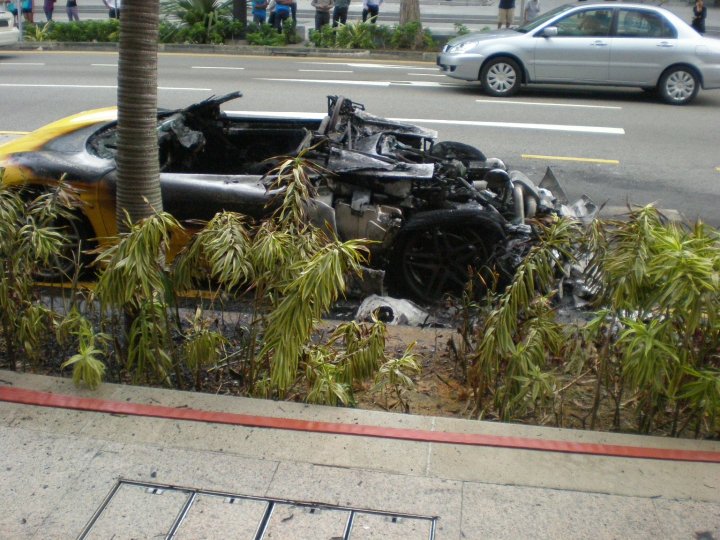
Ferrari On Fire (Singapore)

This must be somewhere in Cityhall area.
Tsk..


Monday, April 5, 2010

Thank you Singapore Airlines!

At Changi Airport Terminal 3 waiting to board my fave plane- Singapore Airlines!


Here she goes..


I had an awesome flight aboard Singapore Airlines going to Jakarta and vice versa.
Wished the flight was longer than an hour.

I was surprised the food rocked my tummy haha! Its really worth it.


Looking forward to be with you again SQ!

:)